
How Consultants Can Scale Revenue by Turning Their Methodology Into a Course
Every consultant eventually hits the same ceiling. There are only so many hours in a week, and every one of them is either billed or unbilled. Revenue is linear - tied directly to your time. You can raise your rate, but at some point you run out of hours to sell.
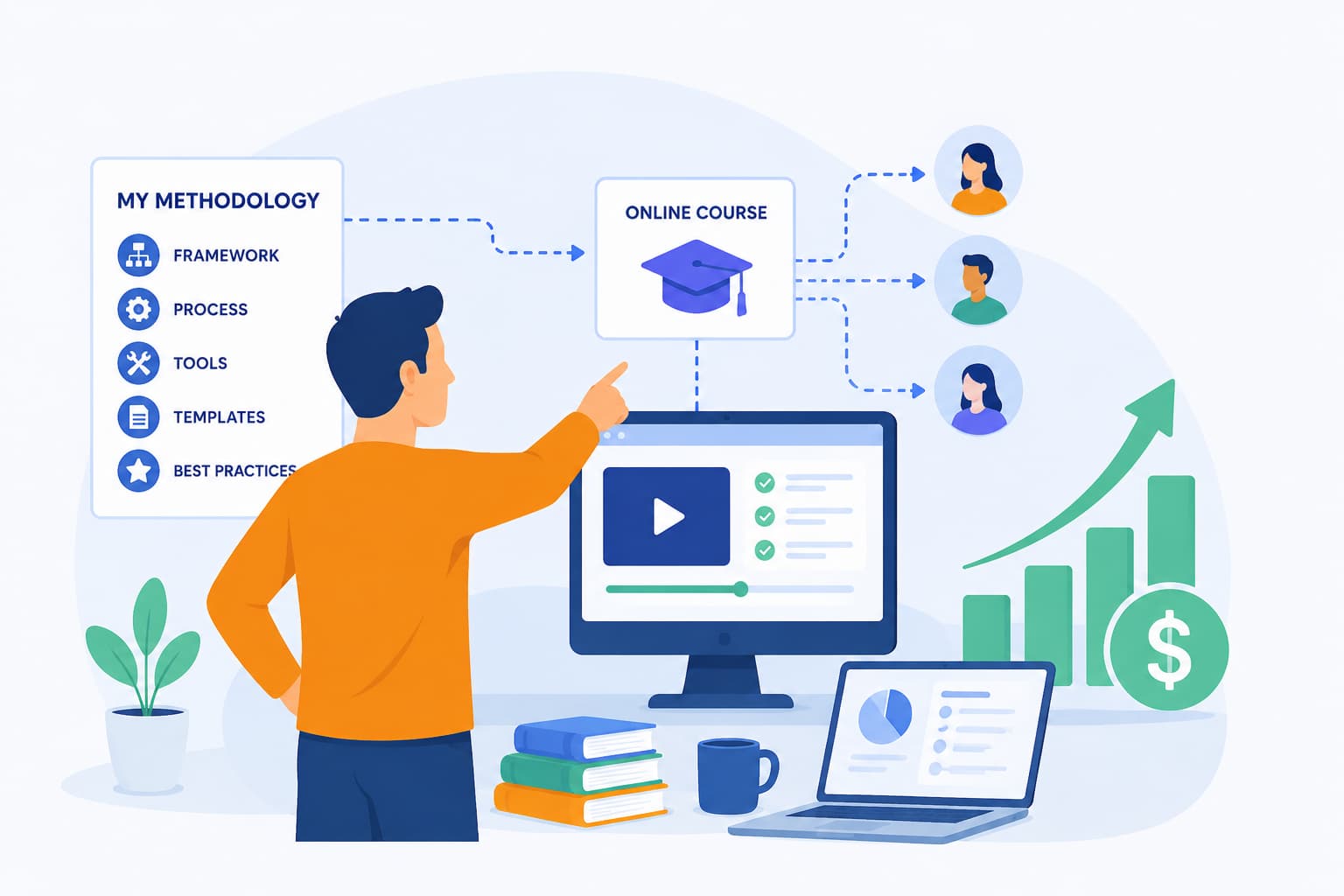
A course breaks that ceiling. Your methodology - the frameworks, processes, and approaches that make your consulting work - becomes a product that sells without your time. One course can generate revenue from dozens or hundreds of buyers simultaneously, while you work with clients, take on new engagements, or do nothing at all.
Why Consultants Are Turning Their Methodology Into Online Courses
Consultants are building online courses because their methodology - the frameworks and processes that clients pay for - can generate revenue without their time. The question most ask is: "Who would buy a course when they could just hire me?" The answer: almost everyone who cannot afford to hire you, and many who can.
Your hourly or project rate puts direct access to your expertise out of reach for a significant portion of the market - smaller companies, early-career professionals, teams in regions where your rates do not fit the local market. A course priced at $197-$497 reaches that entire population. It also reaches professionals who want to learn the methodology themselves, not just have someone implement it.
More importantly: a well-priced course often generates consulting inquiries. When someone takes your course, understands your approach, and wants help applying it in their specific situation - they are already sold on you. Courses function simultaneously as income and as top-of-funnel for higher-value engagements.
What Types of Consulting Expertise Make the Best Online Courses
The best consulting courses are built around repeatable processes - the things you do the same way across every engagement. Not theoretical frameworks from a textbook, but the actual approach you use with real clients, including where you deviate from conventional wisdom and why.
Examples of consulting methodologies that convert well into courses:
- Organizational Change Management (OCM): stakeholder analysis, resistance management, communication planning, adoption tracking
- SAP Customer Service: transaction workflows, service notification and order management, data governance
- Power BI: data modeling, DAX, dashboard design, Power Query transformations, enterprise reporting
- Management consulting: problem structuring, hypothesis-driven analysis, presentation frameworks, client communication
- Financial advisory: modeling approaches, industry-specific accounting, due diligence frameworks
- IT consulting: implementation methodology, requirements gathering, stakeholder management, go-live preparation
If you have a method that works and clients consistently ask you to explain how you do it, that method is course material.
How to Build a Consulting Course Without Months of Production Work
Building a consulting course without months of production work is now possible because AI handles the scripting, narration, and video or audio output - leaving you to contribute only the expertise. The traditional barrier was production: scripting every lesson, recording video, editing audio, designing slides - work that takes weeks and keeps getting pushed. AI eliminates that barrier.
With MakeOnlineCourse, the process is:
- 1.Describe your methodology. Example: "Mini Course: Becoming an Organizational Change Management (OCM) Consultant - covering OCM foundations, key frameworks, client engagement, deliverables, and how to build an independent OCM practice."
- 2.Review the AI-generated curriculum. The AI structures your topic into a logical module-by-lesson flow. Add your signature frameworks, remove anything outside scope, adjust for depth and pacing.
- 3.Edit lesson scripts. Each lesson has a complete narration script. Add your specific examples, client scenarios, perspective on where standard approaches fail, and the nuances that only come from experience. This is what makes the course genuinely yours.
- 4.Process and publish. Choose video ($99) or audio ($19). Download the finished course and sell it on any platform - Udemy, Teachable, Gumroad, or your own site.
Why a Course Library Outperforms a Single Course
A course library outperforms a single course because each new course compounds the effect of the previous ones - creating multiple revenue entry points and reinforcing your authority in the domain. The consultants who generate the most from courses build a library: multiple courses covering different aspects of their domain at different levels of depth. A beginner course introduces the methodology. An advanced course goes deeper on implementation. A specialized course covers a specific sub-topic in detail.
Each course in the library compounds the effect of the others. A buyer who completes your beginner course is a warm lead for the advanced version. A buyer who comes in through your specialized course discovers your broader methodology and buys the foundation course retroactively. Over time, the library generates revenue from multiple entry points simultaneously.
The production cost of adding a course to your library is $99. The marginal cost of a second, third, or fifth course is the same as the first. This is fundamentally different economics from consulting, where adding more work means adding more of your time.
Where and How to Sell Your Consulting Course
Start with the platforms where your target audience already spends time. For B2B consultants, LinkedIn is often more effective than Udemy - your existing professional network is your first audience, and LinkedIn's organic reach for professional content is significant. Post about the course, describe what it covers, and tag the specific audience it is for.
For distribution: Gumroad and Lemon Squeezy work well for direct sales. Udemy provides discovery to a broad audience. Teachable and Kajabi give you more control over pricing, branding, and student communication. Many consultants start with one platform, collect reviews, and expand distribution as momentum builds.
For more on building a scalable consulting business through courses, see our page for consultants.
Frequently Asked Questions
What consulting expertise converts well into an online course?
The best consulting courses are built around repeatable methodologies - frameworks, processes, and approaches you apply across multiple clients. Examples: organizational change management methodology, SAP implementation workflow, Power BI dashboard design process, sales training frameworks, project management playbooks, financial modeling approaches. If you have a method that works and clients consistently ask you to explain it, it is course material.
How do I price a course based on my consulting expertise?
Pricing depends on specificity and audience. General methodology courses (e.g., 'Introduction to OCM') typically sell for $97-$197. Specialized, advanced courses targeting professionals with existing knowledge (e.g., 'Building an OCM Practice from Solo Consultant to Firm') can command $297-$997. Consulting-to-course pricing tends to work best when it is positioned as 'get the framework in hours instead of hiring me for days.'
Will the AI capture my personal consulting style and voice?
The AI generates a strong structural base - curriculum, modules, lesson flow, and narration scripts. Your voice and style come from editing those scripts before processing. Consultants who spend 30-60 minutes reviewing and personalizing scripts typically produce content that reads as genuinely theirs. You can add your signature frameworks, your specific language, your case study examples, and your perspective on where conventional wisdom is wrong.
How long does it take to build a consulting course?
AI generation takes about 10-20 minutes for a full course outline and scripts. Script review and editing typically takes 1-3 hours depending on how much customization you add. Processing into video takes about 30-60 minutes. Most consultants complete their first course in a single working session.
Should I sell a single course or build a course library?
Both approaches work, but a library compounds. Start with your highest-demand topic - the thing clients ask you about most - as a single course to validate the approach. Once it sells, you have proof that demand exists. Your second and third courses benefit from the audience and credibility established by the first. Many consultants build 5-10 courses over time and sell them individually or as bundles.
If you're ready to build, MakeOnlineCourse handles the production side - curriculum, scripts, narration, and finished video or audio - so the only thing you need to contribute is your expertise.
Related posts
- How SAP and Power BI Consultants Can Create Training Courses FastPackage your SAP CS, Power BI, or enterprise software expertise into professional training courses with AI. No production team needed - full course in hours.
- How to Create Employee Training Courses with AI (No eLearning Experience Required)HR and L&D managers: create custom onboarding, compliance, and software training with AI - professional video or audio in hours, at a fraction of agency cost.
- How to Sell Online Courses and Make Money (2026 Guide)Learn how to sell online courses with or without an audience - platforms, pricing, marketing channels, and strategies that actually work.