
How to Create a Food Safety Level 3 Training Course with AI
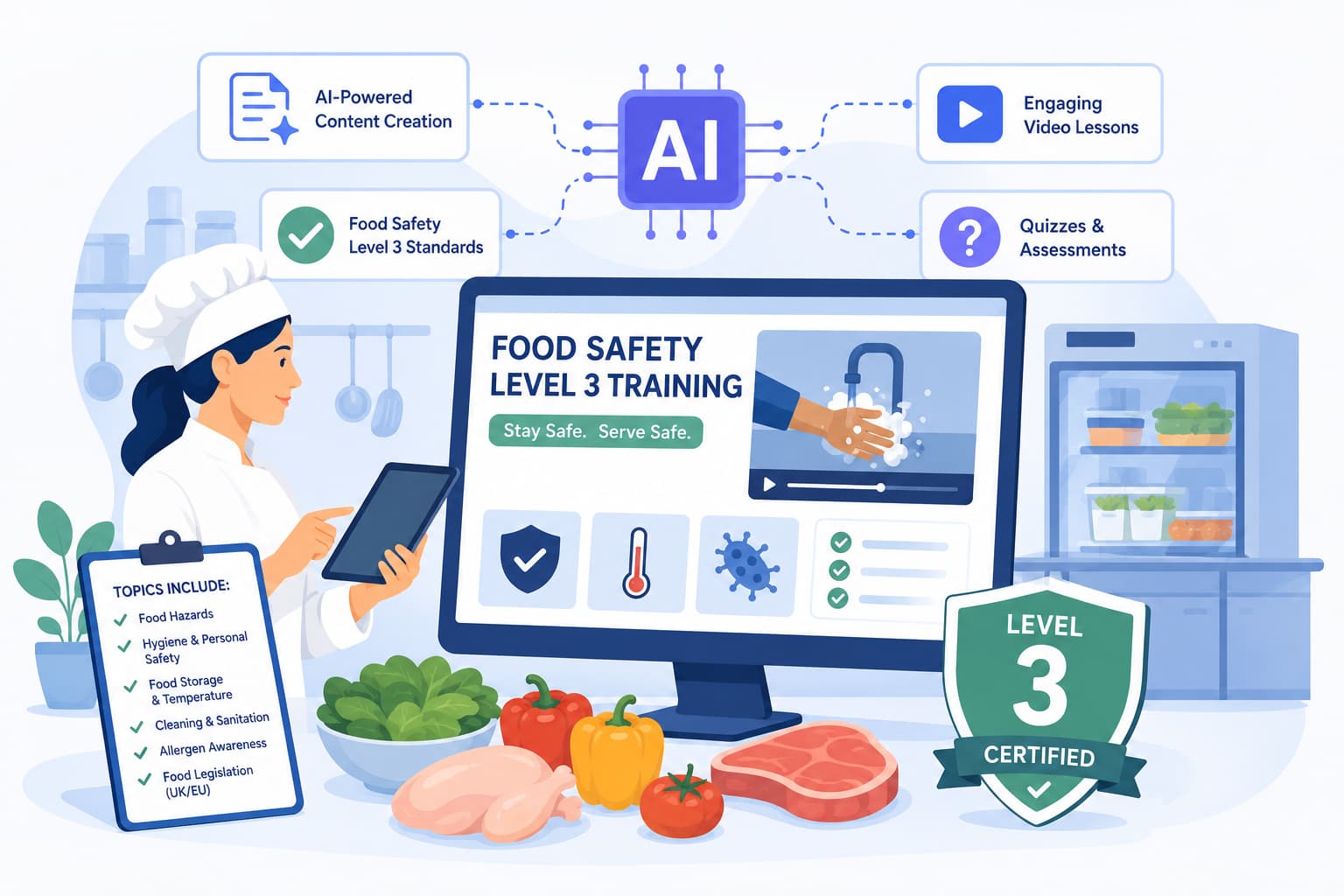
Food safety trainers and managers face a persistent problem: off-the-shelf training content is generic, expensive to license, and rarely matches the specific environment your team works in. Your kitchen is not the same as a mass food manufacturer. Your team's risks are not the same as a hospital kitchen. Generic content fails because it cannot address your specific hazards, your procedures, your equipment.
Building a custom Level 3 food safety training course used to mean hiring an eLearning agency (typically $10,000-$50,000 per course) or spending weeks recording videos yourself. AI course creation has changed that. A food safety professional with no video production experience can now produce a full, professional-quality course in a few hours.
Why Custom Food Safety Training Outperforms Generic Off-the-Shelf Content
Custom food safety training outperforms generic off-the-shelf content for three specific reasons. First, regulators and auditors expect documented, structured training - and being able to show a course your organization built demonstrates a genuine food safety culture rather than a purchased checkbox. Second, custom content is more effective. Staff who see their own workplace, their own equipment, and scenarios relevant to their specific hazards retain more and apply it better. Third, a course you own can be updated. When a regulation changes, you update the relevant lesson. You are not waiting for a third-party provider to push an update.
What a Level 3 Food Safety Course Must Cover
A Level 3 award or certificate in food safety supervision typically requires coverage across these areas:
- Microbiology: foodborne pathogens, bacterial growth, spore formation, toxin production
- Contamination: microbiological, chemical, physical, and allergenic hazards; routes and prevention
- HACCP: the seven principles, critical control points, critical limits, monitoring procedures
- Temperature control: cooking, cooling, chilling, reheating, and hot-holding requirements
- Allergen management: the 14 major allergens, labelling, cross-contact prevention, consumer communication
- Personal hygiene: handwashing, illness policy, protective clothing, and return-to-work requirements
- Cleaning and disinfection: COSHH compliance, cleaning schedules, verification
- Legislation: Regulation (EC) 852/2004, Food Safety Act, due diligence defence
- Supervisory responsibilities: training staff, monitoring compliance, documenting corrective actions
This is exactly the kind of structured, detailed syllabus that AI course generation handles well. The AI understands the domain, builds a logical module structure, and writes detailed lesson scripts for each topic - including examples, case studies, and knowledge-check questions.
How to Build a Food Safety Training Course with AI: Step by Step
The process with MakeOnlineCourse takes four steps:
- 1.Describe your course. Enter something like: "Food Safety and Hygiene Level 3 Certification Preparation - covering HACCP, allergen management, microbiology, temperature control, food safety legislation, and supervisory responsibilities."
- 2.Review the generated curriculum. The AI produces a full module-by-module outline with lesson titles. You can add, remove, or reorder before proceeding.
- 3.Review lesson scripts. Every lesson has a detailed narration script. You can edit any section - add your specific examples, include your organization's procedures, or adjust language for your audience.
- 4.Choose your format. Video course ($99) or audio course ($19). The AI handles narration, visuals, and delivery - you receive downloadable files ready to share.
How to Tailor the Course to Your Food Business
Tailoring the course to your food business means editing the AI-generated scripts to reflect your actual operations. Once the base content is generated, you can update any lesson to:
- Reference your actual HACCP plan and CCPs
- Use your specific temperature recording procedures
- Name your suppliers and describe your delivery process
- Include photos or descriptions of your equipment
- Add your organization's food safety policy and reporting structure
- Incorporate your corrective action procedures
This level of customization is what separates your course from anything an off-the-shelf provider can offer - and it is what makes the training actually useful rather than merely compliant.
Who Uses AI-Generated Food Safety Training
AI-generated food safety training is used primarily by professionals who need consistent, structured content across multiple teams or clients:
- Food safety consultants who deliver training across multiple clients and want consistent, branded content they can adapt per client
- Training managers at hotel groups, restaurant chains, or food manufacturers who need the same Level 3 content delivered to hundreds of staff
- Environmental health practitioners who advise food businesses and want to offer training as an additional service
- HACCP trainers building certification prep content for supervisors and food safety officers
What the Finished Food Safety Course Looks Like
The finished course is a set of downloadable video or audio files - one per lesson - with professional narration (you choose from six voices) and visual slides. You can host them on any LMS, share privately via MakeOnlineCourse's built-in viewer, or distribute via a shared drive. There is no DRM or platform lock-in. The files are yours.
For a full walkthrough of how the course creation process works, see the step-by-step guide. For information specifically about creating certification training courses, including nail technology and vocational licensing, that page has more context.
Frequently Asked Questions
What topics should a Food Safety Level 3 training course cover?
A Level 3 course should cover microbiology and foodborne illness, HACCP principles and critical control points, temperature control, allergen management, personal hygiene, cleaning and disinfection, food safety legislation, and supervisory responsibilities. MakeOnlineCourse generates a full curriculum covering all these areas automatically from your topic description.
How long does it take to create a food safety training course with AI?
The AI generation stage takes about 5-15 minutes - producing a full curriculum, lesson scripts, professional voiceover narration, and video output. Total time from idea to a downloadable course is typically under an hour, compared to weeks with traditional eLearning development.
Does the course need to be formally accredited to be useful for training?
Not necessarily. Many food businesses use custom-built courses for internal staff induction, refresher training, and supervisory development alongside or instead of formal accreditation. The course content is yours to structure as needed - whether that's preparation for a formal exam or standalone workplace compliance training.
How do staff access the finished training course?
You download the finished video or audio files and share them however makes sense - an LMS, a private website, a shared drive, or MakeOnlineCourse's built-in course sharing feature. No technical setup required on the learner's side.
Can I update the course when food safety regulations change?
Yes. You can return to MakeOnlineCourse, regenerate specific lessons or scripts to reflect updated legislation, and reprocess just those sections. You are not locked into a static product.
How much does it cost to create a food safety training course with AI?
Generating the curriculum and scripts is free. Processing into a full video course costs $99, or an audio course costs $19. Compare that to traditional eLearning development which typically costs $5,000-$50,000 per hour of content from a studio.
If you want to save the time and cost of traditional course production, MakeOnlineCourse can take you from a topic description to a complete narrated video or audio course in a few hours - no recording equipment or editing experience needed.
Related posts
- How to Create Employee Training Courses with AI (No eLearning Experience Required)HR and L&D managers: create custom onboarding, compliance, and software training with AI - professional video or audio in hours, at a fraction of agency cost.
- Best Online Certificate Programs in 2026 (Free & Paid)The best online certificate programs in 2026, by field - tech, business, project management, and design. Free and paid options, plus how to spot a legit program.
- How Real Estate Agents Can Create Homebuyer Education Courses with AIReal estate agents and mortgage advisors: stop repeating the same explanations. Build a professional homebuyer education course once and share it with every client.